
Slowdown and liquidity squeeze by RBI have put India's top 10 indebted firms in a tight spot. But they have a few options.

After years of losing money on two of the group's biggest bets - global steel business and domestic passenger cars - there are strong signs of a revival in both businesses.

With commodity markets remaining soft and uncertain, it is likely the money will flow into equity markets with strong upsides, such as India.

Most analysts expect growth in the sales of Nifty-50 companies to decelerate, albeit marginally, in the quarter ended December compared to the corresponding period of 2013-14, with metals and real estate companies pulling down earnings.

Wiping off nearly Rs 4 lakh crore of investors' wealth during the day, benchmark Sensex crashed on Friday.

In the domestic market, the Tata Group has lost ground in the passenger car business.

These firms reported a combined operating profit of Rs 26,077 crore (Rs 260.77 billion).
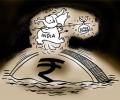
FIIs have offloaded stocks worth Rs 13,110 crore

This weakness is likely to continue in the near-term.

This is largely on the back of Tata Steel's expansion at Kalinganagar, as well as JLR's in China and Brazil

67 companies with total debt of Rs 5.65 lakh cr were either loss-making or didn't generate enough profit to cover interest cost in FY15

Sales expansion also down 4.4%

A full-blown recovery remained elusive for India Inc in the July-September quarter, even as it overcame the challenge of achieving profitable growth.

This was even as the country's economy grew by 7.3%.

Over the past four quarters, the Sensex companies' earnings trajectory has improved sharply because of a weak rupee.

In India, bond yields have fallen nearly 70 basis points in the last one year.

That resulted in a 50-basis point improvement in operating profit margins on a sequential basis.

Nifty 50 firms' net profit estimated to grow by a modest 3.1% in Q2, reports Krishna Kant.

Rising oil prices and diminishing cash pile to limit capacity in 2018-19

Many analysts find market expensive, even at current levels.

Mid- and small-cap companies seem to have done better than top-tier companies
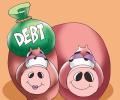
Corporate India at present is more indebted than all state govts put together.


Indian companies typically have higher return on equity.

The gap between Nifty's price-earnings multiple and economic growth is at a 12-year high

For equity investors, the risk-to-reward ratio is worsening.

With cash -- the primary medium of exchange -- all but disappearing, it is now unlikely that the expected fillip to demand on account of a good monsoon and proceeds from the Seventh Pay Commission payout will materialise.

Benchmark share indices gained for the fifth straight session on Thursday led by index heavyweight Reliance Industries.

'The government is encouraging consumption through fiscal spending in a bid to push up economic growth in the face of a slowdown in corporate investment and exports.'

Investors turn their attention to export-driven sectors.

Earnings spread for foreign investors down to 10-year low of 1.1 per cent, from 2 per cent at the beginning of the year and record high of nearly 5 per cent in 2013

Fresh investments by corporates up just 5.8% in FY17, lowest since 1992

Fourteen per cent of the $16 billion invested by Ratan Tata in M&As abroad has been written off by his successor.

Total net debt-equity ratio improves for third consecutive year, while investment in new projects hits a 10-year low, says Krishna Kant.
.jpg)
Revenue yield on every rupee of investment fell to Rs 1.06 in FY13 from Rs 1.20 in FY08.

The sharp fall in the rupee's value against the dollar during the July-September quarter, it turns out, has come as a boon for corporate earnings.

Stock prices is due to valuation expansion
Net profit grew 25.4% in Q4 but revenue growth, lower at 8.5%, suggests lack of volume expansion.

Companies from the capital goods space will under-perform.

India Inc did not perform well during December quarter.
 © 2026 Rediff.com - Advertise with us - Disclaimer - Privacy Policy - Sitemap - Feedback - About us - Terms of use - Grievances